AI SEO tools have gone from a curiosity to a crowded market in about two years. New vendors launch every month, and every one of them promises to fix your visibility in ChatGPT. Most of that noise is not worth your budget. A handful of tools genuinely earn their place.
So this guide sorts the AI SEO tools market for you. I have grouped 15 tools into five clear categories, because they solve different problems and buying the wrong category wastes money. You will also find an honest section on what these tools cannot do, which vendors rarely put in their marketing.
One note before we start. I have deliberately left prices out. Plans change constantly in this category, and half the roundups you will read quote figures that were already stale when they published. Check the current pricing page before you buy anything.

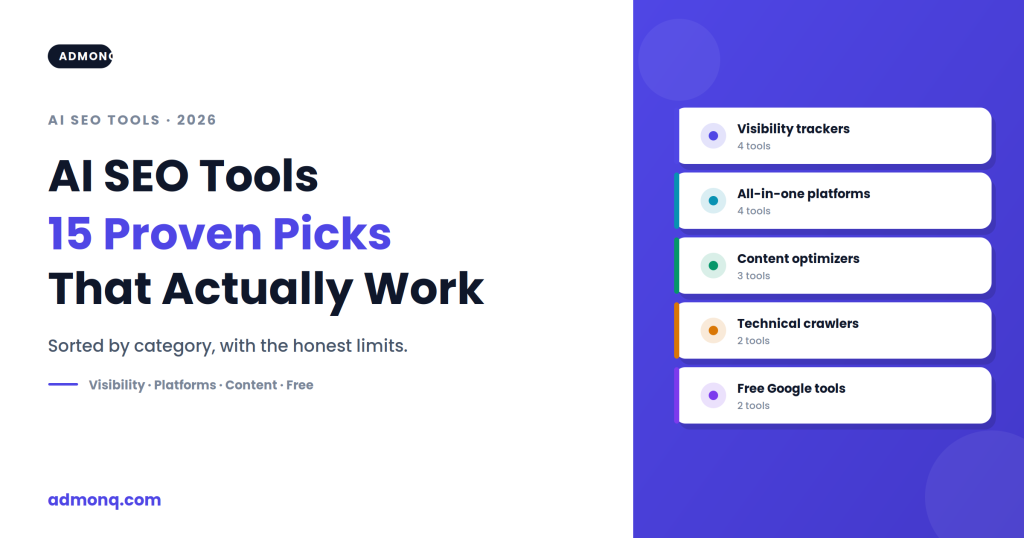
Five categories, five different jobs. Buy for the gap you actually have.
What are AI SEO tools?
AI SEO tools are software that uses machine learning to speed up or improve some part of search work. That covers a wide range, from keyword clustering to content scoring to tracking whether ChatGPT mentions your brand.
The label gets stretched, though. Some products are genuinely built on AI. Others simply added a chat box to an existing dashboard and rebranded. Therefore, judge a tool by the job it does rather than by the word “AI” on its homepage.
In practice, the useful tools fall into five groups. Visibility trackers measure your presence in AI answers. All-in-one platforms give you classic SEO data with AI features attached. Content optimizers help you write pages that match what already ranks. Technical crawlers find what blocks indexing. Finally, the free Google tools give you first-party data that no third party can match.
How do AI SEO tools actually use AI?
It is worth knowing what the label covers, because “AI” gets applied to very different things. In practice, AI SEO tools use the technology in four distinct ways.
First, clustering and classification. A tool takes thousands of keywords and groups them by meaning rather than by matching words. That job used to take an analyst a full day. Now it takes seconds, and it is probably the most reliable use of AI in this category.
Second, generation. This covers drafting outlines, meta descriptions, schema markup and full articles. Quality varies enormously here, so treat generated output as a first draft rather than a finished asset.
Third, querying the models themselves. Visibility trackers work by sending prompts to ChatGPT, Perplexity and others, then parsing what comes back. The AI is the subject being measured rather than the engine doing the work.
Fourth, summarizing and prioritizing. Several platforms now read your audit data and tell you what to fix first. That is genuinely useful when a crawl returns 400 issues, though the ordering still needs a human check.
Notice that only the first and third are new capabilities. The rest are conveniences layered on work you could already do. Consequently, the strongest AI SEO tools are the ones honest about which of these four they actually deliver.
Why did the AI SEO tools market split in two?
This is the shift that matters most for buying decisions in 2026. Two years ago, you bought one SEO platform and that was that. Now there are two distinct camps, and they do not fully overlap.

Two camps, built from opposite directions. Most serious teams currently run one of each.
On one side sit the established platforms. Ahrefs, Semrush and Moz spent years building keyword databases, backlink indexes and rank trackers. Recently they bolted AI visibility modules onto that foundation. As a result, you get AI data sitting next to your organic data, in a tool your team already knows.
On the other side sit vendors built only for AI search. They run prompts across ChatGPT, Perplexity, Gemini and Claude, then report whether your brand appeared and which sources got cited. Because that is all they do, their tracking usually goes deeper than the bolt-on modules.
So which camp wins? Right now, neither. Dedicated trackers give more thorough AI coverage, while established platforms give you everything else. Most serious teams therefore run one of each. Over time I expect these to merge, since AI visibility is becoming a standard part of SEO reporting rather than a separate discipline. If the underlying strategy is new to you, start with my guide to generative engine optimization before you spend anything on tooling.
Best AI SEO tools for visibility tracking
These tools answer one question: when people ask an AI assistant about your topic, does your brand come up? They work by running a set of prompts across the major engines, then measuring the results.

Four numbers worth watching. Track the trend rather than the exact figure.
1. Profound
Profound is one of the more established names in this category and aims at enterprise teams. It tracks brand mentions across the major assistants, shows which sources the models pull from, and benchmarks you against competitors. Consequently, it suits organizations that need board-level reporting on AI visibility rather than a quick check.
2. Peec AI
Peec AI covers a notably broad set of platforms, which matters if your audience uses more than ChatGPT. Broad coverage is its main selling point. So if you want the widest monitoring net rather than the deepest single-engine analysis, it is worth a look.
3. Otterly AI
Otterly focuses on monitoring brand visibility and mentions across leading AI systems, and it identifies which sources those systems reference. It also flags content gaps where you are underrepresented. Because it is lighter than the enterprise options, smaller teams tend to find it more approachable.
4. Scrunch AI
Scrunch sits in the same monitoring category and is frequently cited alongside the names above. Like its rivals, it tracks prompts, mentions and competitive position. Since the feature sets in this category are converging quickly, I would judge these four on interface, price and support rather than on feature lists alone.
Before you buy any tracker Run your own prompts manually first. Open ChatGPT and Perplexity, ask ten questions a customer would ask, and note whether you appear. That free exercise tells you whether you have a visibility problem at all, and it takes twenty minutes.
Best all-in-one AI SEO tools
These are the workhorses of most stacks. They handle keyword research, backlinks, rank tracking and audits, and each has added AI capability recently. If you only buy one category of AI SEO tools, buy this one.
5. Ahrefs
Ahrefs remains the tool I open most often, mainly for the strength of its keyword and backlink data. Its Brand Radar feature extends that into AI visibility, tracking your brand across AI search alongside places like YouTube and Reddit. Usefully, it also reports which of your pages have been cited and on which platforms. That page-level citation view is genuinely helpful, because it tells you what to publish more of.
6. Semrush
Semrush is broader than Ahrefs and weaker in places, but its range is hard to beat. Its AI visibility toolkit shows how assistants describe your brand compared with competitors, which is useful for positioning as well as SEO. In addition, Semrush publishes solid research on this category, including its own roundup of GEO tools.
7. Moz Pro
Moz Pro is the friendliest of the big platforms for people newer to SEO. It tracks rankings, visibility and traffic across large keyword sets. While its data depth trails Ahrefs and Semrush, its interface and learning resources make it a reasonable first platform for an in-house marketer.
8. Writesonic
Writesonic takes a different approach by bundling AI search tracking, content writing, optimization and site audits into one platform. Its AI search tracking covers ChatGPT, Perplexity, Google AI Overviews, Gemini and Claude, and its site audit checks both classic SEO and GEO issues. If you would rather manage one subscription than four, it is the obvious candidate. However, bundles always trade depth for convenience, so test it against your actual workflow.
Best AI SEO tools for content optimization
These AI SEO tools analyze the pages already ranking for a query, then tell you what a competitive page needs to cover. As a result, they are the fastest way to turn research into a usable brief.
9. Surfer SEO
Surfer builds content briefs from live search results and scores your draft as you write. Writers tend to like it because the feedback is immediate and concrete. Just remember that its score is a guide, not a grade from Google.
10. Frase
Frase is built around research and question coverage. It pulls the questions people ask around a topic and helps you structure an article that answers them. Because AI assistants respond to conversational questions, that question-first approach has aged well.
11. Clearscope
Clearscope is the premium option, and editorial teams favor it for good reason. Its term recommendations are cleaner than most, and its reports are easy to hand to a freelance writer. Still, it is priced for teams that publish constantly rather than occasionally.
A warning about content scores Optimization scores measure similarity to pages that already rank. They cannot measure originality, accuracy or first-hand experience, which are exactly the things that set content apart now. Hit a reasonable score, then stop optimizing and add something only you can say.
Best technical AI SEO tools
Before an AI system can cite you, a crawler has to reach and render your pages. These AI SEO tools find what stands in the way.
12. Screaming Frog
Screaming Frog crawls your site the way a search engine would and surfaces broken links, redirect chains, missing tags and duplicate content. Its free tier handles up to 500 URLs, which covers a lot of small sites completely. It is the first tool I run on any new audit, and it pairs directly with my technical SEO checklist.
13. Sitebulb
Sitebulb crawls similar ground but explains its findings better. Instead of a raw list of issues, it gives prioritized recommendations with the reasoning attached. Therefore, it works well when you have to hand an audit to a developer or a client who does not live in SEO.
Best free AI SEO tools
The best free AI SEO tools come from Google itself. You can run a complete SEO program without spending anything, and these two entries are non-negotiable.

Start with the free stack. Add paid tools when a free one starts costing you hours.
14. Google Search Console
Search Console is the single most valuable SEO tool in existence, and it is free. It shows the actual queries bringing you clicks, your index coverage, and your Core Web Vitals on real user data. No third-party tool can match it, because the data comes straight from Google. If you use nothing else on this list, use this.
15. Google Trends and Keyword Planner
I count these as one entry because they work together. Google Trends shows rising topics and seasonal patterns, so you can spot demand before competitors do. Google Keyword Planner gives volume ranges from the source itself. Together they cover the core of keyword research for most sites.
| Tool | Category | Best for |
| Profound | AI visibility | Enterprise reporting on AI presence |
| Peec AI | AI visibility | Broadest platform coverage |
| Otterly AI | AI visibility | Smaller teams starting with GEO |
| Scrunch AI | AI visibility | Prompt and competitor monitoring |
| Ahrefs | All-in-one | Best keyword and backlink data, plus page-level citations |
| Semrush | All-in-one | Widest feature range and competitor gaps |
| Moz Pro | All-in-one | Newcomers who want a gentler interface |
| Writesonic | All-in-one | One subscription covering SEO, content and GEO |
| Surfer SEO | Content | Live scoring while you write |
| Frase | Content | Question coverage and research |
| Clearscope | Content | Editorial teams publishing at volume |
| Screaming Frog | Technical | Fast, thorough crawls, free up to 500 URLs |
| Sitebulb | Technical | Audits you hand to developers or clients |
| Search Console | Free | Your real query, index and Core Web Vitals data |
| Trends + Keyword Planner | Free | Demand, seasonality and volume ranges |
What AI SEO tools cannot do
Here is the section most roundups skip. AI SEO tools have real limits, and knowing them changes how you read every report you get.

The honest limits. None of these make the tools useless, but all of them change how you read the data.
AI answers are not stable. The same prompt returns different answers depending on the user, the exact wording, the location and whether live search is on. Consequently, two people running the same check can get different results on the same day.
Rank tracking does not transfer cleanly. There is no fixed position one inside a generated answer. So when a tool reports your AI “ranking”, treat it as an estimate built on sampled prompts rather than a measured position.
These tools sample, they do not census. A tracker runs a defined list of prompts. It cannot see the millions of real conversations happening, which means your true visibility is inferred rather than observed.
No tool proves causation. If your visibility rises after you publish something, the tool cannot tell you the publication caused it. Model updates, competitor changes and pure variance all move these numbers too.
None of this makes the category worthless. It does mean you should watch direction over months instead of reacting to weekly wobbles. Above all, do not build a client report around a single number that moves on its own.
How do you choose the right AI SEO tools?
Match your AI SEO tools to the stage you are at now. I see far more money wasted on unused enterprise seats than on tools that were too cheap.

Buy for the stage you are at, not the one you hope to reach next year.
Solo or small site. Use Search Console, Google Trends and the free Screaming Frog tier. Add a general AI assistant for drafting and clustering. That costs nothing and covers the fundamentals properly.
Growing business. Add one all-in-one platform and one content optimizer. Keep the free Google tools running alongside, since they remain your only source of first-party data. Consider an entry-level AI visibility tracker once AI referrals show up in your analytics.
Agency or enterprise. You will likely need two data platforms, because their indexes differ, plus a dedicated GEO tracker and a scheduled crawler. At this stage, API access and reporting matter as much as the underlying data.
Whichever stage you are at, remember that tools support strategy rather than replace it. A clear plan run on free tools beats an expensive stack nobody opens. Google says much the same thing in its guidance on creating helpful content, which is worth reading before any purchase.
How to test AI SEO tools before you buy
Nearly every vendor offers a trial, yet most people waste it clicking around the dashboard. Here is the process I use instead, and it takes about an hour per tool.
Start by writing down three questions you need answered. For example: which pages get cited by AI assistants, which keywords are competitors winning that we are not, or what is blocking our new section from being indexed. Then judge the trial only on those three questions.
Next, run the tool against a site you know intimately. Your own site works best, because you can immediately spot whether the data is right. If a tool reports issues you know are false, or misses problems you know exist, that tells you more than any feature list.
After that, check the export. Can you get the data out cleanly as a CSV or through an API? Tools that trap your data become expensive to leave later, so this matters more than people expect at signup.
Finally, time yourself. Measure how long a routine task takes in the tool compared with your current method. Since most AI SEO tools sell time savings rather than new information, that number is the real return on the subscription.
Mistakes to avoid when buying AI SEO tools
Buying before you have a problem. Subscribing to a visibility tracker before you know whether AI mentions you is backwards. Check manually first, then buy if the gap is real.
Paying for overlapping tools. Ahrefs and Semrush overlap heavily. Unless you need both indexes, one is usually enough for a smaller team.
Trusting a content score as a ranking prediction. Scores measure similarity to current results. They cannot see originality, accuracy or first-hand proof, which is what my guide to E-E-A-T content covers in depth.
Automating structured data blindly. Several tools now generate schema for you. Always check the output against your visible page content, using the rules in my schema markup guide.
Confusing AI visibility with SEO. They overlap, but they are not the same discipline, and the reporting is different. I break the distinction down in my post on SEO versus GEO.
Frequently asked questions
Do I need a dedicated AI visibility tool?
Not immediately. First check manually whether AI assistants mention you, and watch your analytics for referrals from ChatGPT or Perplexity. If those referrals are meaningful, or a client asks for AI reporting, then a tracker earns its cost. Otherwise the AI modules inside Ahrefs or Semrush are usually enough to start.
Can AI SEO tools replace an SEO specialist?
No. They speed up research, reporting and drafting, which frees up hours. However, they cannot set strategy, judge what matters for your business, or decide which of fifty flagged issues to fix first. The tools handle the work, while a person decides the direction.
Are free AI SEO tools good enough?
For many small sites, yes. Search Console alone gives you data no paid tool can replicate, since it comes directly from Google. Paid tools buy you scale, competitor data and time savings rather than better fundamentals.
How accurate is AI visibility tracking?
Directionally useful, precisely unreliable. Because AI answers change with wording, location and settings, any single figure is a sample rather than a measurement. Watch the trend across months, and treat sharp weekly swings with suspicion.
How many tools should I actually pay for?
Most growing businesses need two or three: one data platform, one content optimizer, and possibly one visibility tracker. Beyond that, tools tend to overlap and go unused. Audit your subscriptions twice a year and cancel whatever nobody opened.
Are AI SEO tools worth it for a small business?
Often yes, but start with the free ones. Search Console and Google Trends answer most questions a small site has. Once you find yourself repeating the same manual task every week, that is the signal a paid tool will pay for itself.
Will AI SEO tools write content that ranks?
They will produce content quickly. Whether it ranks depends on whether a knowledgeable person shapes, verifies and adds to it. Unreviewed generated articles published at volume tend to underperform, because they contain nothing a reader cannot find elsewhere.
Not sure which tools you actually need?
At Admonq we already run this stack across client accounts, so we can tell you what will move your numbers and what would sit unused. If you would rather skip the trial-and-error, let us take a look at your setup.
→ Get a tooling recommendation The AI SEO tools market will keep moving, and this list will need updating within a year. The underlying principle will not change though. Pick the smallest stack that answers your real questions, learn it properly, and spend the time you save on the work no tool can do for you: original research, first-hand testing, and content that says something nobody else can.