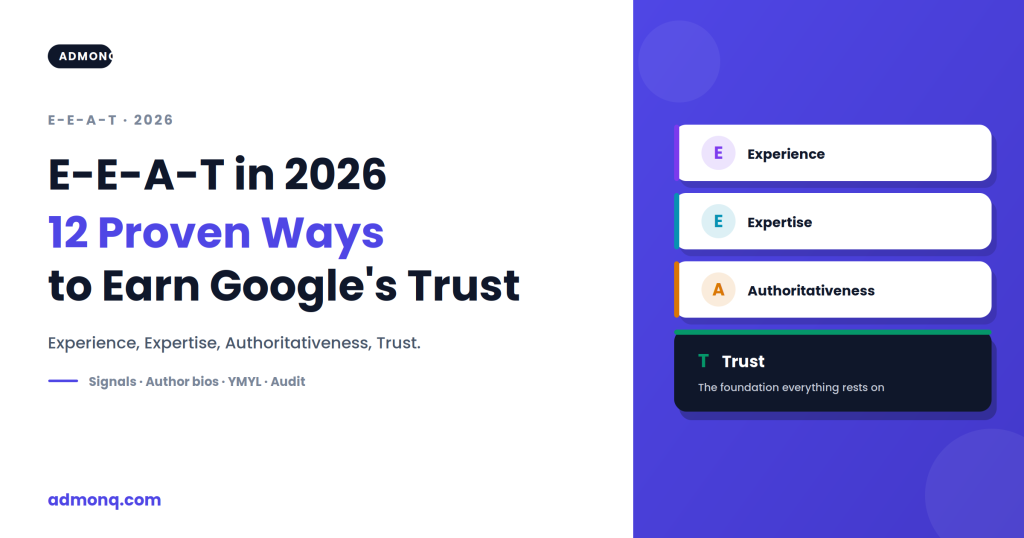
E-E-A-T is the framework Google uses to judge whether your content deserves to rank. It stands for Experience, Expertise, Authoritativeness and Trust. Get it right, and your pages earn credibility that competitors cannot copy overnight. Ignore it, and even well-optimized content quietly slides down the results.
I have watched this play out for years. A client publishes solid articles, builds decent links, and fixes the technical issues. Yet nothing moves. Then we add named authors, real credentials, and first-hand proof, and suddenly the same content starts to climb. Nothing else changed.
So this guide covers what E-E-A-T actually means, why Trust sits above the rest, and the 12 signals I use to prove it on real sites. I will also show you how to audit your own pages. Let us start with the basics.

Three signals sit on top of one. Trust is the foundation the others rest on.
What does E-E-A-T stand for?
E-E-A-T stands for Experience, Expertise, Authoritativeness and Trust. These are the qualities Google’s human quality raters use when they score search results. Their scores do not change your rankings directly. Instead, they train the systems that do.
Meanwhile, each letter asks a different question about your content. Experience asks whether you have first-hand involvement with the topic. Expertise asks whether you actually know the subject. Authoritativeness asks whether others recognize you for it. Trust asks whether your site and page are accurate, honest and safe.
Notice that these build on each other. You can have deep expertise and still fail on trust. In that case, the expertise does not save you. That relationship matters more than any single tactic in this guide.
Why Trust matters most
Google is explicit on this point. A page with low trust cannot be considered high quality, however experienced or expert the author is. Trust is evaluated at the page level and at the whole-site level too.
So think about what that means in practice. A brilliant article on a site with no contact details, no author, and a shady reputation still fails. Therefore, fix trust problems before you polish anything else. It is the foundation, not a finishing touch.
Who are Google’s quality raters?
Quality raters are trained contractors, not Google engineers. Google employs thousands of them around the world. Their job is to score search results against a public manual, and that manual is where E-E-A-T lives.
Crucially, Google states plainly that rater scores do not directly influence the ranking of any individual page. Instead, the ratings measure how well the search systems are performing. Engineers then use that feedback to improve the algorithms themselves.
The manual is public, which is unusual and useful. You can read the current Search Quality Rater Guidelines yourself. It runs to roughly 180 pages, and the version published on 11 September 2025 is the one still in use through 2026.
Reading it is genuinely worthwhile. Admittedly it is long, yet it tells you the exact target Google’s algorithms are tuned toward. Few SEO resources come that close to an answer key.
Is E-E-A-T a ranking factor?
No, and this is where a lot of advice goes wrong. There is no E-E-A-T score inside Google’s algorithm. You cannot optimize a number, because no such number exists.
So why does it matter? Because E-E-A-T describes the qualities Google’s systems are built to reward. The raters measure whether the algorithm is hitting that target. As a result, improving your E-E-A-T means aligning with what the algorithm is tuned to find.
This distinction protects you from bad advice. Anyone selling an “E-E-A-T score” or promising a direct ranking lift is guessing. The real work is slower and more honest: prove who you are, prove you know the subject, and prove people can rely on you.
How I explain it to clients E-E-A-T is not a lever you pull. It is a description of the kind of site Google wants to rank. You do not optimize for it directly. You become the thing it describes, and the signals follow.
How did E-A-T become E-E-A-T?
The framework has evolved over more than a decade. Knowing that history helps, because it shows the direction Google keeps moving in.

A twelve-year evolution. Each step raised the bar for proving who stands behind the content.
Google first introduced E-A-T in 2014, inside its Quality Rater Guidelines. Initially, few people paid attention. That changed in August 2018, when the update widely nicknamed Medic hit health and finance sites hard. Sites without credible authorship and transparent sourcing lost heavy visibility almost overnight.
Then in December 2022, Google added the second E for Experience. In its announcement of the change, Google explained that it wanted to know whether content was produced with some degree of experience, such as actually using a product or visiting a place. That was a meaningful shift. Research alone was no longer enough.
The guidelines were then substantially updated in September 2025. That version added rules around AI-generated content, expanded the spam categories, and widened the definition of sensitive topics. It remains the current version in 2026.
What is YMYL, and does it apply to you?
YMYL stands for Your Money or Your Life. It covers content that could affect someone’s health, financial security, safety or wellbeing. Google holds this content to a much higher standard, because bad information can cause real harm.

YMYL is a spectrum, not a switch. The higher the potential harm, the higher the bar.
Most people assume YMYL means only medical and financial sites. However, that is far too narrow. Careers, education, housing, and major purchases all carry weight. Since September 2025, the definition also covers civics, government and election information.
So ask yourself a simple question. If someone acted on this page and the information was wrong, could it damage their health, money or safety? If the answer is yes, you are in YMYL territory. Consequently, every signal in this guide matters more for you.
12 proven ways to prove E-E-A-T
Here is the practical part. These are the 12 signals I work through on client sites, grouped by pillar. You do not need all of them at once. Start with the ones that are missing entirely.

Three practical signals per pillar. This is the checklist I run on client sites.
Experience signals (1 to 3)
1. Use original photos and screenshots. Stock images prove nothing. Your own screenshots of a tool you actually used, or photos of a place you visited, are hard evidence. They are also the single hardest signal for a competitor to fake.
2. Publish first-hand case studies. Write about work you did, with real numbers and real outcomes. Even so, a small honest case study beats a broad general overview. Because it comes from practice, it contains details that research alone never surfaces.
3. Say plainly what you tested. Tell the reader what you personally tried, how long you used it, and what went wrong. That last part matters. Admitting a failure is a strong credibility signal, and almost nobody does it.
Expertise signals (4 to 6)
4. Give every article a named author. An “admin” byline signals that nobody stands behind the page. A real name changes how the whole article reads, and it costs nothing to fix.
5. Show credentials where they are real. List qualifications, certifications and years of practice, but only ones you genuinely hold. Inventing credentials is a trust failure that is easy to catch and hard to recover from.
6. Write with the depth only practice gives. Cover the edge cases, the exceptions, and the parts that trip people up. Surface-level content is now trivially easy to produce, so depth is what separates you.
Authoritativeness signals (7 to 9)
7. Earn citations from trusted sites. Links and mentions from recognized sources in your field build authority faster than volume ever did. One mention from a respected industry site outweighs dozens of low-quality links.
8. Build consistent brand mentions. Ideally your name appears across your industry, even without a link. Search engines and AI systems both read these mentions as recognition signals.
9. Cover topics in clusters, not one-offs. A single article proves little. A connected set of articles covering a topic thoroughly proves you own that subject. This is exactly why I structure this blog around pillars and clusters, an approach that starts with proper keyword research.
Trust signals (10 to 12)
10. Make contact and ownership obvious. A real about page, a working contact method, and clear company details are basic trust requirements. Their absence is a red flag to raters and readers alike.
11. Cite your sources and show your dates. Link to where a claim came from, and display when the page was published and last updated. Both are cheap to add and both raise credibility immediately.
12. Correct errors in the open. When you get something wrong, fix it and say so. Visible corrections signal an editorial process, which is one of the strongest trust markers a site can have.
Where to start If you only do one thing this week, add real author bios. Experience and Expertise both flow through the author, so a credible bio lifts every article you have ever published. It is the highest-return fix on most sites.
How do you write an author bio that builds trust?
Author bios are where most sites lose easy ground. Simply printing a name does almost nothing. A proper bio, however, turns an anonymous page into a credible one.
The highest-return fix on most sites. Every element here answers a reader’s silent question.
A strong bio includes a real name and a real photo, rather than a stock portrait. Then it states the person’s role and how long they have worked in the field. Next, it lists genuine credentials, and it says what the author has actually done rather than what they know about.
Then it links to profiles a reader can verify, such as LinkedIn or a professional page. Finally, it shows an editorial signal, like a review note or a last-updated date. Together, these answer the question every reader silently asks: why should I believe this person?
Mark the author up properly too. Person schema connects your author to a machine-readable identity, which helps search engines link the content to a real entity. I cover exactly how to implement it in my schema markup guide.
What does E-E-A-T look like for your type of site?
The framework applies everywhere, but the proof looks different depending on what you publish. Here is how I approach each type.
Blogs and content sites
Your author is your strongest asset. Consequently, invest in bios, consistent bylines, and topic clusters that show genuine depth. Original screenshots and personal results carry more weight here than anywhere else, because your product is the knowledge itself.
Ecommerce stores
Trust signals dominate. Shoppers and raters both look for clear returns policies, real customer reviews, visible contact details and secure checkout. Additionally, original product photography beats manufacturer stock images, since it proves you actually handle what you sell.
Local businesses
Consistency is everything. Your name, address and phone number should match across your site, your business profile and every directory listing. Furthermore, genuine reviews and photos of your actual premises do more for local credibility than any amount of written copy.
YMYL and professional services
Here the bar is highest. Show real qualifications, name the person responsible for the advice, and add an editorial or expert review step. Above all, cite authoritative sources for factual claims, because raters check them.
How does E-E-A-T affect AI search?
This part has grown quickly, and it deserves an honest answer rather than a hopeful one.
AI systems summarize and cite sources they treat as reliable. The signals that make a site credible to a search engine, such as clear authorship, cited claims and consistent recognition, also make it a safer source for an AI answer. So the work overlaps heavily.
However, nobody outside Google can measure an exact E-E-A-T contribution to an AI citation. What I can say with confidence is that anonymous, unsourced content gives an AI system no reason to trust it. If you want the mechanics of earning AI citations specifically, I cover them in my guide to generative engine optimization, and I compare the two disciplines in my breakdown of SEO versus GEO.
Consider what an AI system needs in order to cite you safely. It has to identify who produced the content and whether that source has a track record. Named authors, verifiable profiles and cited claims all supply that. Anonymous content, by contrast, offers nothing to verify.
There is also a practical connection worth naming. If crawlers cannot reach or render your author pages and content, none of these signals register at all. That makes your technical SEO foundation a prerequisite for E-E-A-T, not a separate project.
How to audit your own E-E-A-T
You can assess your own site in under an hour. Work through these five checks in order, because the early ones usually explain the later problems.

Five checks, in order. Most sites fail on the first two.
| Check | What to look for | Fix if missing |
| Byline | Does every article name a real, credited author? | Replace “admin” with a named person |
| Author bio | Does that author have a page proving who they are? | Build bios with role, years and links |
| First-hand proof | Original images, data or case studies on key pages | Add your own screenshots and results |
| Sources and dates | Claims cited, publish and update dates visible | Link sources, display both dates |
| Site-wide trust | About, contact, policies and clean reputation | Complete the pages, monitor mentions |
Run this quarterly rather than once. Meanwhile sites drift, authors leave, and pages go stale. A quick review each quarter keeps small problems from becoming structural ones. Several tools can speed up parts of this, and I round up the useful ones in my guide to AI SEO tools.
E-E-A-T mistakes to avoid
Inventing credentials. Fake expertise is a trust failure, and it is easy to check. The damage far outweighs any short-term gain.
Publishing anonymous content at scale. Volume without authorship now works against you. Google’s 2025 guidelines specifically target scaled content produced mainly to rank rather than to help. Its guidance on creating helpful content is the standard to write against.
Treating E-E-A-T as a content-only job. In reality, trust is site-wide. A great article on a site with no about page still struggles, because raters assess the whole site as well as the page.
Copying competitors instead of showing your own work. If your content only restates what already ranks, you have no experience signal at all. Your own tests and results are the part nobody else can reproduce.
Ignoring reputation off your site. Raters research what others say about you. Reviews, forum threads and news coverage all count, so unresolved complaints quietly undermine your pages.
Frequently asked questions
Is E-E-A-T a confirmed ranking factor?
No. There is no E-E-A-T score in Google’s algorithm. It is a framework describing the qualities Google’s systems aim to reward, and quality raters use it to evaluate whether those systems are working. Improving it aligns you with the target, which is why it matters.
How long does it take to improve E-E-A-T?
Some fixes are immediate. Adding author bios, contact details and source citations can be done in a day, and they change how every page reads. Authority signals take far longer, often many months, because they depend on other sites recognizing you.
Does E-E-A-T apply to small sites?
Yes, and small sites often have an advantage. A genuine practitioner writing from real experience can demonstrate the Experience signal far better than a large publisher outsourcing content. You do not need scale to show credibility.
Can AI-generated content have good E-E-A-T?
It can, provided a real expert directs, verifies and stands behind it. Google judges content by quality and usefulness rather than how it was produced. What fails is unreviewed content published at scale with no named author and no first-hand insight.
What is the fastest E-E-A-T win?
Author bios, without question. Experience and Expertise both flow through the author, so one good bio page lifts every article that person has written. Most sites can complete this in an afternoon.
Does E-E-A-T matter more for YMYL sites?
Yes, considerably. Google applies its strictest quality standards to content that could affect health, finances, safety or civic decisions. Ordinary topics still benefit from strong credibility signals, but YMYL pages are held to a noticeably higher bar.
How do I show experience if I am new to a field?
Document what you actually do as you do it. Publish your own tests, screenshots and results, even from small projects. Honest beginner experience, clearly labelled, is far more credible than pretending to an authority you have not earned yet.
Want help proving your E-E-A-T?
At Admonq we audit credibility signals, fix the gaps, and build the authorship and trust foundations that search engines and AI systems both reward. If you would rather have experts handle it, let us take a look at your site.
E-E-A-T rewards the slow, unglamorous work: put your name on your writing, show what you have actually done, cite what you claim, and make it easy to find out who you are. None of that is a trick. That is precisely why it keeps working while tactics come and go.
